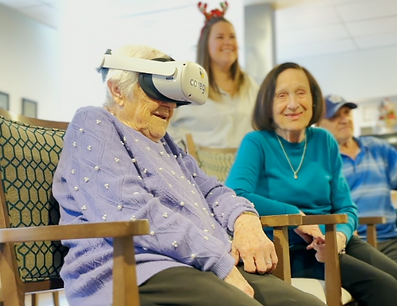
The Research Behind Virtual Reality in Senior Care
caregiVR is the result of over a decade of clinical research and user-engagement. We work with researchers, clinicians, therapists, and senior living communities to understand how immersive technology can meaningfully support the health and well-being of older adults.
Research demonstrates that VR is more than just engaging technology—it can help residents feel more connected, support cognitive and emotional health, create joyful experiences, and empower caregivers in delivering person-centered care.
On this page, you’ll find research organized by the key outcomes that matter most in senior care. Whether you’re an administrator, recreation therapist, or family member, this hub provides a clear, evidence-based look at how VR can enhance quality of life in long-term care.
The Benefits of Virtual Reality
Virtual reality offers more than entertainment — it creates meaningful experiences that support emotional well-being, social connection, cognitive stimulation, and caregiver support. Through immersive, senior-friendly environments, residents can relax, reminisce, explore, and engage in ways that feel both safe and empowering. For care teams and families, VR becomes a practical, non-pharmacological tool that enhances quality of life while strengthening connection and daily care experiences.

Emotional Well-Being
Supports mood, eases anxiety, and encourages meaningful engagement.

Social Connection
Fosters connection, sparks conversation, and brings people together.

Cognitive Stimulation
Encourages exploratory thinking and strengthens memory function.

Caregiver Support
Provides a tool to enhance resident care while offering respite and reducing stress.
Browse Our Latest Research
Innovation in senior care must be supported by evidence. Read our published studies examining virtual reality as a non-pharmacological intervention for seniors, including its impact on engagement, emotional regulation, and quality of life. Explore the findings that guide our clinical and operational approach.
Abstracts
Appel, L., Kisonas, E., Appel, E., Rosenberg, J., and Smith, C. (2020).
Administering Virtual Reality Therapy to Manage Behavioural and Psychological Symptoms in Patients with Dementia Admitted to an Acute-care Hospital: Results of a Pilot Study.
13th Clinical Trials on Alzheimer's Disease (CTAD) November 4-7.
Journal of Preventative Alzheimer’s Disease, 7(S1):S55-S119.
Chen, B., Appel, L., Kisonas, E., Appel, E., Rosenberg, J., and Smith, C. (2020).
Predicting Response to Virtual Reality Therapy for Treatment of BPSD in Acute-care Settings.
13th Clinical Trials on Alzheimer's Disease (CTAD) November 4-7.
Journal of Preventative Alzheimer’s Disease, 7(S1):S55-S119.
Appel, L., Narang, T., Ali, S., Wiseman, M., Ein, E., Orchanian-Cheff, A., and Campos, J. (2020)
Exploring evaluation methods of Virtual Reality interventions for individuals living with Dementia: a scoping review.
10th Canadian Conference on Dementia (CCD) Québec City, October 3, 2019.
Canadian Geriatrics Journal, 23(1), 4-87
Appel, L., Kisonas, E., Appel, E., Rosenberg, J., and Smith, C. (2020).
Virtual Reality therapy for inpatients with dementia admitted to an acute-care hospital: Learnings from a pilot to pave the way to a randomized controlled trial.
13th Clinical Trials on Alzheimer's Disease (CTAD) November 4-7.
Journal of Preventative Alzheimer’s Disease, 7(S1):S55-S119.
Appel, L., Ali, S., Narang, T., Wiseman, M., Ein, E., Orchanian-Cheff, A., and Campos, J. (2020).
Exploring technological characteristics of Virtual Reality interventions for individuals living with Dementia: a scoping review.
10th Canadian Conference on Dementia (CCD) Québec City, October 3, 2019.
Canadian Geriatrics Journal, 23(1), 4-87
Appel, L., Bogler, O., Appel, E., Wiseman, M., Cohen, L., Hill, D., Ein, N., Abrams, H., and Campos, J. (2018).
Prescribing Virtual Reality (VRx): Can exposure to simulated natural environments using Virtual Reality (VR) offer an alternative therapy for those living with dementia...
9th Canadian Conference on Dementia (CCD) Toronto, November 2017.
Canadian Geriatrics Journal, 21(1), 71-133